Zhejiang Minglong New Material Technology Co., Ltd. is a PVC Mesh Banner manufacturer working from our own plant in the Tongxiang Economic Development Zone, Zhejiang, China. We calender, laminate and coat flexible PVC materials in-house and supply mesh banner roll goods to wide-format printers, signage fabricators, distributors and cover converters. Orders range from 1.6 m roll widths up to 3.2 m, with a standard minimum order quantity of 2,500 meters.
Established in 2005 and located close to the Shanghai and Ningbo ports, our plant combines a Jiaxing Municipal High-tech Research and Development Center with an integrated production chain, so development work, trial rolls and bulk runs stay under one quality system. Mesh sits inside our wider flex banner material programme alongside frontlit and backlit banner, blockout and tarpaulin lines.
- Two Taiwan-made PVC calenders with 4 m and 2.88 m working width
- Five laminators, four lamination machines and two coating lines
- Annual output of 30,000 t of PVC laminated film and 85 million m² of finished fabric
- IQC, in-line IPQC and OQC inspection sequence, with REACH, RoHS and EN71 compliance
- Patent certificates covering process and material construction work
How Open-Mesh Banner Material Performs Outdoors
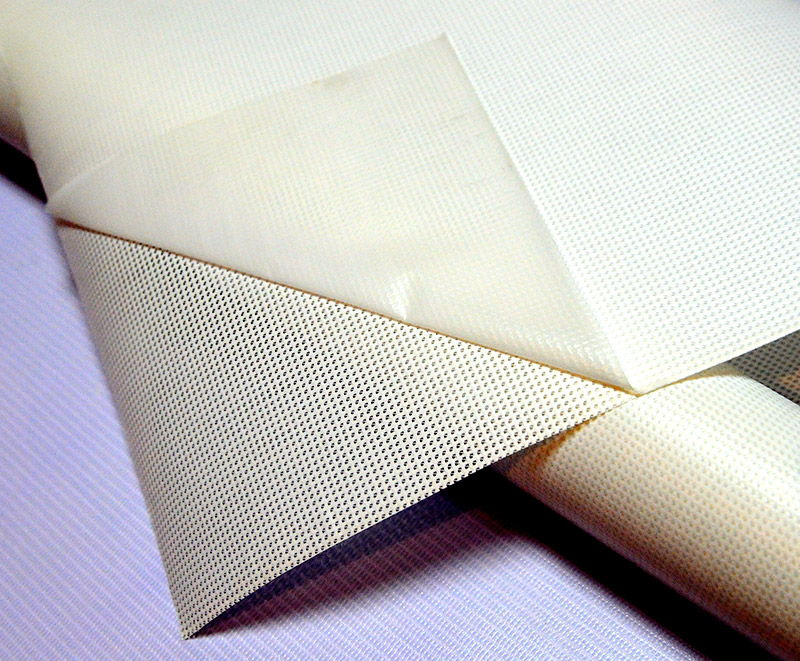
Mesh banner is built on a woven polyester scrim, coated with PVC and perforated by the open gaps between warp and weft yarns. Air passes through the sheet instead of loading it, which keeps large façade, scaffold and fence graphics stable in gusting wind and lets daylight through from behind. The coated face carries the print; the reverse side stays a plain PVC surface.
- Lower wind load than solid banner at the same panel size
- Reduced flapping and eyelet stress on exposed hoardings and building wraps
- Partial see-through for scaffold work and glazed façades
- Softer hand and lower roll weight for easier handling at height
Because the sheet is perforated, mesh is not a water-tight or vapour-barrier material. Where a job needs sealed coverage rather than airflow, our PVC Tarpaulin Material range is the correct family to specify.
Our Mesh Range and Specification Envelope
Three scrim constructions cover the common print and installation duties, all supplied with a PVC liner for roll stability and clean handling on flatbed and roll-to-roll equipment.
| Model |
Base fabric |
Threads / inch² |
Tensile strength (N/5 cm) |
Tear strength (N/5 cm) |
Widths (m) |
| MLMF1199P |
1000×1000D |
9×9 |
≥900 / ≥1100 |
≥270 / ≥300 |
1.6, 2.5, 2.8, 3.2 |
| MLMF1812P |
500×1000D |
18×12 |
≥1000 / ≥1200 |
≥320 / ≥350 |
1.6, 2.5, 3.2 |
| MLMF1212P |
1000×1000D |
12×12 |
≥1300 / ≥1500 |
≥260 / ≥360 |
1.6, 2.5, 3.2 |
All three models are rated for service between −30 °C and 70 °C and carry a PVC liner. Roll length, core diameter and packing are fixed per order. The dense 18×12 scrim gives the smoothest print surface and the highest tear values, while 9×9 offers the most open area and the lowest weight for very large panels.
Application Fit Across Signage and Industrial Work
Building wraps and scaffold cladding
Large printed panels on high structures, where airflow through the sheet lowers load on the frame and fixings.
Site hoarding and fence graphics
Perimeter branding that stays readable from both sides in daylight and survives repeated wind exposure.
Event and stadium branding
Backdrops, ribbon banners and temporary façades that need light weight and fast installation.
Shade and ventilation screens
Converted panels for car parks, plant screening and covered walkways where partial airflow is required.
Printing, Liner and Finishing Compatibility
The coated surface accepts eco-solvent, solvent, UV-curable and latex inks used in wide-format production. We recommend a small trial roll before a full run so ink load, drying and profile settings are confirmed on your own printer. Our PVC liner mesh banner material roll keeps the face flat through the press and protects it during cutting and transport.
- Liner: PVC liner applied to the reverse, specified per order
- Finishing: hemming, eyelet spacing and heat welding planned to the installation method
- Panel planning: seams placed away from high-stress corners and fixing points
- Storage: keep rolls upright, dry and out of direct sun before printing
Quality Control, Testing and Acceptance
Incoming resin, plasticiser and base fabric are checked at IQC; coat weight, width, surface and liner release are monitored in-line at IPQC; finished rolls are inspected at OQC before packing. Our control plan follows REACH, RoHS and EN71 requirements, and retained samples are kept against each batch for traceability.
- Base fabric denier, thread count and mass per unit area
- Tensile strength and tear strength in both yarn directions
- Coating adhesion, surface whiteness and print-side cleanliness
- Width tolerance, roll build, splicing and liner continuity
- Batch records and reference samples retained for repeat orders
Acceptance criteria are agreed in writing before production, and rolls are checked against that schedule rather than a generic standard, so the first delivery and the tenth follow the same specification.
Roll Widths, Packaging and Delivery
Mesh rolls are wound on cores, wrapped for sea freight and labelled to the buyer's packing list. Shipments leave through Shanghai and Ningbo, with air freight available for urgent trial quantities. Our materials are supplied to customers in Southeast Asia, Europe, North America, Japan, Korea and Australia.
Information We Use to Configure Your Mesh Specification
- Application, mounting method and expected wind exposure
- Print process and ink type, with panel size and viewing distance
- Preferred scrim (1000×1000D or 500×1000D) and target mass per square meter
- Minimum tensile and tear values if the job carries a structural requirement
- Roll width, roll length, core size and liner requirement
- Colour, whiteness and any flame or chemical compliance condition
- Finishing plan: hem width, eyelet pitch or welding specification
- Quantity per delivery, packaging, labelling and destination port
Send drawings, samples or a finished-graphic specification and we will confirm the matching construction, roll format and production schedule. Where a requirement falls outside the three standard builds, our R&D center develops coatings, widths and liner combinations against the supplied sample.
Frequently Asked Questions
Which widths and quantities can you produce?
Standard widths are 1.6 m, 2.5 m, 2.8 m and 3.2 m depending on model, with roll length set per order. The standard minimum order quantity is 2,500 meters, and custom widths are developed against a sample or drawing.
How do I choose between 9×9, 12×12 and 18×12 mesh?
Thread count sets the balance between openness and strength. 9×9 gives the most open area for very large panels, 12×12 is the general-purpose print build, and 18×12 offers the densest surface and the highest tear values for demanding installations.
Is the PVC liner supplied as standard?
Yes. All three mesh models are supplied with a PVC liner that stabilises the roll and protects the print face. Liner type and release behaviour are confirmed with the order specification.
Which inks work on your mesh banner material?
Eco-solvent, solvent, UV-curable and latex inks are all used on this surface. We supply a trial roll so ink load, drying and colour profile can be verified on your printer before bulk production.
Can you develop a custom mesh construction?
Yes. We develop and produce against customer drawings or samples, adjusting scrim, coating weight, width, colour and liner within our calendering, lamination and coating capability.
How are the rolls packed for export?
Rolls are wound on cores, wrapped and labelled to the agreed packing list, then shipped by sea from Shanghai or Ningbo. Air freight is available when a trial or urgent quantity cannot wait for a sailing.

 English
 Category


 +86-573-88890126
 adam@ml-holding.cn
 No. 28, Shuguang Road, Tudian Town, Tongxiang City, Zhejiang Province, 314503, China
