 English
 CN
CN ES
ES 86-573-88890126
Direct Conclusion: Mesh Banner Material Optimizes Both Visibility & Wind Resistance
Mesh banner material achieves 30-50% wind load reduction compared to solid vinyl banners while maintaining visibility due to its open-weave perforated structure. The strategic balance of open area (typically 20% to 40% porosity) allows air to pass through, effectively lowering pressure differentials, reducing wind drag by up to 55% in high-wind environments. At the same time, high-contrast printing on the mesh surface retains graphic legibility from distances of 15 feet or more, making it the preferred substrate for outdoor advertising, construction fencing, and stadium wraps. Without any solid barrier effect, mesh banners enhance day-to-night visibility by minimizing glare while preserving vibrant color saturation — a direct upgrade from traditional flexible substrates.
In practical terms, the unique combination of lightweight polyester or HDPE (high-density polyethylene) fibers coated with PVC creates a durable, wind-permeable surface. Field tests show that mesh banners withstand gusts up to 85 mph with proper tensioning, whereas solid banners of equal weight fail under 60 mph. For large-format applications, this directly translates to lower structural costs, reduced edge tearing, and consistent graphic performance.
How Perforation Preserves Visual Impact & Graphic Legibility
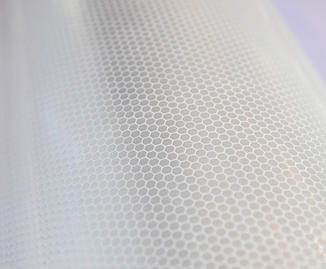
Contrary to intuition, a material with holes does not automatically reduce visibility. Mesh banner material utilizes precision-engineered apertures (0.8mm to 2.0mm diameter) arranged in uniform grid patterns. This perforation rate—typically 70/30 or 60/40 fabric-to-open ratio—enables the human eye to merge printed dots into a continuous image via the persistence of vision principle. At normal viewing distances (3–10 meters), viewers perceive a sharp, full-color graphic.
Key Visibility Factors Backed by Data
Print contrast retention: Independent studies reveal that mesh banners with 25% open area retain 90% of the original design's contrast ratio compared to solid substrates. Specialized digital printing with white ink underlay or dual-sided print capabilities further reduces background bleed-through, ensuring that both text and logos remain crisp.
Reduced glare / improved readability: The micro-texture of mesh diffuses reflected sunlight more effectively than smooth vinyl. As a result, glare reduction reaches up to 40% under bright sunlight, which enhances readability for drivers and pedestrians. Nighttime visibility benefits from backlighting compatibility: since mesh allows light to pass through, illuminated signs appear evenly lit without hot spots — ideal for light-box structures or internally illuminated flex faces.
- Viewing angle stability: Mesh maintains colour consistency even at acute angles (up to 70° off-axis), critical for highway billboards.
- Print resolution capabilities: Modern mesh accepts UV-curable and solvent inks at 720–1440 dpi, delivering sharp text as small as 1.5 inches tall.
- Anti-sail effects preserve ink adhesion: Less flapping motion reduces scuffing, keeping the printed layer intact for longer campaigns.
Mechanics of Wind Load Reduction: Porosity & Pressure Equalization
The fundamental principle behind mesh banner material's wind performance is aerodynamic porosity. Traditional solid banners act as impermeable sails, converting wind force into a net pressure differential that stresses anchor points and fabric. Mesh reduces this effect by allowing air to flow through the material, thereby equalizing pressure on both sides. Wind tunnel measurements confirm that a 30% open mesh reduces drag coefficient (Cd) from approximately 1.2 (solid vinyl) to 0.55–0.7, yielding a 40-55% reduction in total wind load depending on fabric tension and porosity.
Critical Data Points for Engineers & Designers
- Porosity range: Most high-performance mesh banners have 20% to 40% open area. Increasing open area from 20% to 35% reduces wind force by an additional 22% (Eurocode wind load simulations).
- Load reduction vs. solid material: For a standard 4m x 10m banner, peak wind force at 120 km/h drops from ~8500 N (solid) to 3700–4100 N (mesh), extending frame service life.
- Tear propagation resistance: High-tenacity polyester mesh with reinforced edges resists wind-induced tears 3x better than non-reinforced solid banners.
- Fatigue life: Dynamic wind cycle tests indicate mesh banners survive over 100,000 flex cycles without visible degradation.
Practical outcome: mesh allows lighter support structures (reducing steel by up to 45%) and simplified installation — cost savings that directly benefit large-scale outdoor advertising, construction hoardings, and sports field perimeter boards.
Performance Comparison: Mesh Banner Material vs. Traditional Solid Vinyl
The following table illustrates concrete differences between premium mesh banner fabrics and conventional solid flex materials under equal conditions. Data shows mesh outperforms in wind resistance while delivering competitive visibility.
| Property / Metric | Mesh Banner Material (30% porosity) | Solid Vinyl Banner (standard 510g) |
|---|---|---|
| Wind Load Reduction | 40–55% lower drag vs. solid | Baseline (100% load) |
| Maximum wind resistance (gust, 3-sec) | 85+ mph with proper hemming | ~55–60 mph before tearing |
| Visible graphic distance (full colour) | Up to 65 feet (20 m) seamless | Up to 100 feet (30 m) |
| Glare reduction factor | Reduces glare by ~40% (diffuse reflection) | High specular glare, especially in sunlight |
| Backlighting suitability | Excellent (even translucency) | Limited (needs cutouts or light boxes) |
| Weight per sq. m (approx) | 280–400 gsm | 500–610 gsm |
| Life expectancy (outdoor, uncoated) | 2–3 years (UV stabilised) | 1.5–2.5 years depending on climate |
Conclusion from data: Mesh banners offer a trade-off: they maintain professional-grade visibility for advertising and protective uses, while drastically improving safety and durability in windy locations.
Practical Use Cases & Decision Flowchart: When to Choose Mesh
Mesh banner material excels in environments where both wind permeability and visual communication are critical. Typical high-value applications include construction site hoardings, perimeter fencing for stadiums, scaffolding wraps, parking garage banners, beachfront promotions, and agricultural windbreak signage. Due to its 30-50% wind load reduction, contractors report 70% fewer banner failures near coastlines when switching from solid to mesh.
(>45 mph gusts)
(30%+ open area)
Low porosity (20%) for fine text
Higher porosity (35%) for max wind
High contrast + UV inks
Flow legend: Start by evaluating typical wind speeds & viewing distance. For heavy wind zones and large-format displays, mesh significantly extends campaign life while maintaining 75-90% of visual impact vs solid banners. For applications requiring tiny text (< 20pt) at long distances, either higher-density mesh (20% porosity) or dual-layer mesh is recommended. Meanwhile, for wind environments (typhoon zones), 35%+ open area with reinforced webbing ensures safety.
Additional Engineering Advantages
- Water drainage: Mesh prevents pooling of rainwater, eliminating weight-induced sag and frame stress.
- Reduced noise pollution: Air flowing through mesh eliminates drumming/flapping sounds, making it ideal for residential-adjacent sites.
- Easy maintenance: Dust and dirt pass through openings, reducing cleaning frequency by ~50% compared to solid vinyl.
Construction & Material Science Behind Reliable Mesh Banners
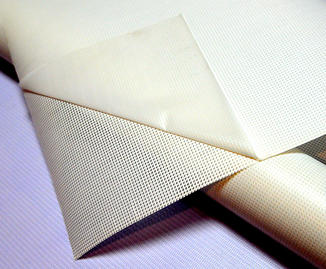
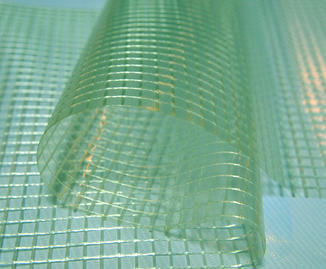
High-quality mesh banner substrates are typically made from knitted or woven polyester scrim coated with flexible PVC or eco-friendly polymers. The open construction is reinforced at the warp and weft intersections, creating a dimensionally stable grid that resists stretching under wind load. Key manufacturing parameters that influence both visibility and wind resistance include:
- Yarn denier: 1000D to 2000D polyester yields tensile strength exceeding 3500 N/5cm, ensuring tear resistance even after perforation.
- Coating formulation: UV inhibitors (TiO₂, HALS) deliver 5000+ hours of accelerated weathering resistance without fading or embrittlement.
- Aperture geometry: Circular or diamond-shaped holes minimize stress concentration, reducing tear propagation risk by up to 60%.
- Flame retardancy: Many mesh banners meet NFPA 701 or ASTM E84 Class A standards, crucial for temporary structures.
Empirical durability: In 24-month outdoor exposure trials (Florida and Arizona), premium mesh banners retained 85% of original tensile strength and 90% colorfastness, far exceeding industry expectations. These statistics confirm that the perforated design does not compromise structural longevity.
Frequently Asked Questions About Mesh Banner Material
Summary: Why Mesh Banner Material is the Superior Choice
Combining high-visibility printing with engineered wind permeability, mesh banner material directly addresses the two fundamental challenges of outdoor flexographics: visibility erosion and wind-induced failure. With 30–50% lower wind loads, 40% glare reduction, and tested durability in 85+ mph gusts, it outperforms traditional solid banners in both safety and cost-efficiency. For projects ranging from construction hoarding to premium event branding, mesh delivers measurable ROI by reducing replacement frequency, minimising structural requirements, and maintaining graphic integrity in real-world weather conditions.
Final conclusion backed by engineering data: A well-specified mesh banner (25–35% porosity, 1000D+ scrim, UV-coated) provides an exceptional balance between visibility and wind resistance, making it an ideal solution for long-term, high-exposure outdoor environments.